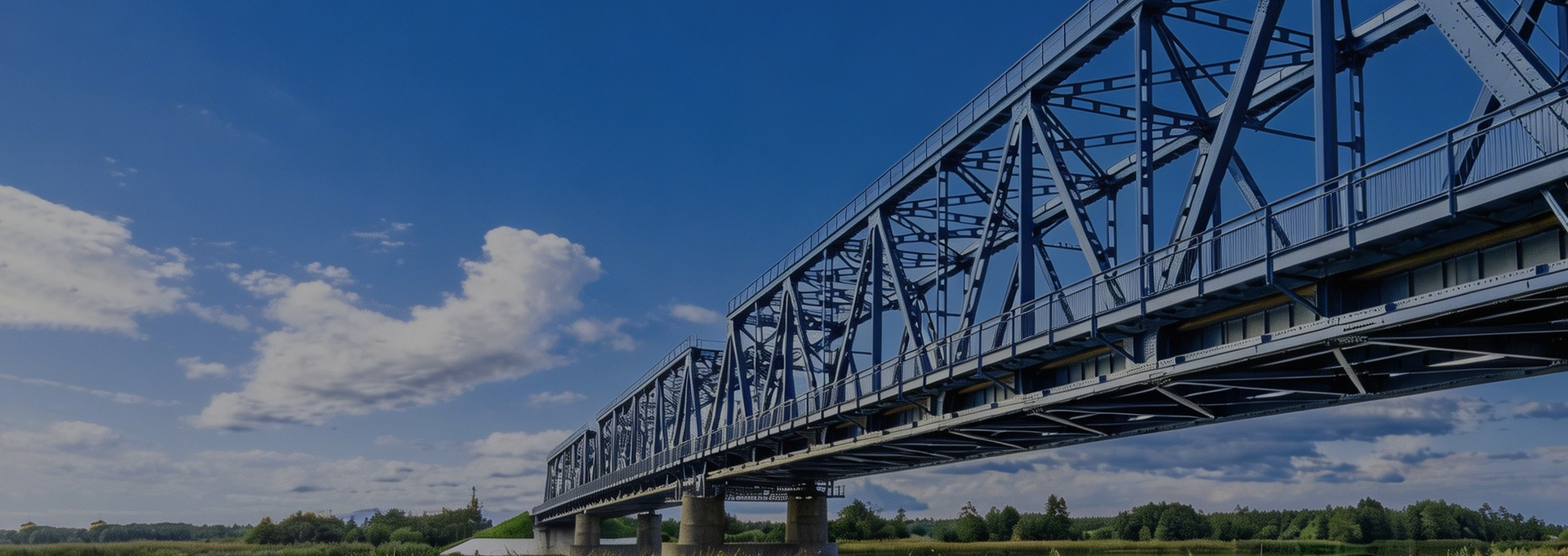
Among the most fundamental questions in structural engineering is: what is the strongest truss pattern? Whether you are designing a highway bridge, a railway span, an industrial roof, or a long-span pedestrian walkway, the geometry of the truss you choose determines how forces travel through the structure, how much material is required, and how safely the finished structure will perform under load. The answer is not a single name — it depends on span length, loading type, and construction material. But the engineering logic behind each pattern is clear, and understanding it transforms an abstract question into a precise, decision-ready framework.
Every truss design, regardless of its specific pattern, derives its structural power from one geometric principle: the triangle is the only shape that is inherently rigid under load. A rectangular frame will rack and collapse when a lateral force is applied to it. A triangle, by contrast, cannot change shape without deforming at least one of its sides. This rigidity means that loads applied to any point in a properly triangulated truss are immediately resolved into axial forces — either tension pulling the member apart, or compression pushing it together — with no bending moment induced within individual members.
This distinction between axial loading and bending is central to understanding truss strength. A solid beam resists load through its cross-sectional resistance to bending, which requires significant material depth. A truss achieves the same span using far less material by routing the same load through a network of slender, axially stressed members. The chord members — the top and bottom horizontal elements — carry the primary bending effect of the span as opposing forces of compression and tension. The web members — the diagonals and verticals between the chords — carry the shear forces. The specific arrangement of those web members defines the truss pattern.
Two material properties are decisive. Steel is exceptionally strong in tension — slender rods and cables can carry enormous tensile loads without failure. However, long, slender steel members under compression are vulnerable to buckling: a sudden lateral collapse that can occur well before the material's compressive yield strength is reached. The strongest truss pattern for any given application is therefore the one that minimises compression in long members and maximises the structural use of tension wherever possible.
The Pratt Truss: The Strongest Pattern for Steel Under Gravity Loading
Patented in 1844 by Thomas and Caleb Pratt, the Pratt truss is widely regarded as the most structurally efficient pattern for steel structures across the most common span range. Its defining characteristic is the orientation of its diagonal web members: they slope downward toward the centre of the span. Under standard downward (gravity) loading, this arrangement places the diagonals in tension and the vertical members in compression. The top chord carries compression; the bottom chord carries tension.
By placing the longer diagonal members in tension rather than compression, the Pratt truss eliminates the primary buckling risk associated with those members. Tension members can be made slender and lightweight because steel resists being pulled apart very efficiently. The compression members — the verticals — are kept short, which further limits their susceptibility to buckling. This dual advantage produces a structure that achieves high load-bearing capacity with a comparatively modest amount of material, delivering superior strength-to-weight ratio.
Pratt trusses also handle dynamic and variable loads effectively. Because tension in the diagonals manages the shear forces that shift as moving loads cross the span, the Pratt pattern performs reliably under both uniform and concentrated loading — making it the dominant choice for highway and railway bridges throughout the steel age and into the present.
Structural Characteristics of the Pratt Truss
- Diagonal members slope toward the centre and carry tension under gravity loading
- Vertical members carry compression and are kept short to resist buckling
- Top chord in compression; bottom chord in tension — efficient use of steel in both roles
- Excellent performance under both uniform and dynamic (moving) loads
- Optimal span range: 10 m to 60 m under predictable downward loading in steel
The Warren Truss: Most Material-Efficient for Medium-Span Bridges
The Warren truss, introduced in 1848, is characterised by its series of equilateral or isosceles triangles formed by alternating diagonal members, with no verticals in its basic form. Under a uniformly distributed load, the diagonals alternate between tension and compression depending on their position within the span, distributing shear forces evenly across the entire structure.
For modern road and rail bridges of medium span, the Warren truss is often considered the most material-efficient design available. Geometrically, it uses fewer web members than the Pratt or Howe patterns, reducing the total number of connections and fabricated components. Fewer members means lower material cost, faster fabrication, and reduced construction time. The equilateral triangle geometry also distributes stress evenly across the structure, preventing the concentration of force that can lead to localised failure.
In practice, most Warren trusses used in bridges incorporate intermediate vertical members added between the diagonal nodes. These verticals handle concentrated point loads, reduce the effective panel size, and improve the truss's performance under shifting or asymmetric traffic loads. The Warren-with-verticals configuration is frequently cited by engineers as the optimal starting point for medium-span steel bridge design where loads vary in position — such as live traffic loading — because the alternating diagonal pattern handles force reversal more gracefully than the Pratt.
Compared with the Pratt, the Warren pattern requires heavier steel sections because its diagonals must be sized to carry both tension and compression depending on load position. This offset in member weight is typically outweighed by the saving in member count, making the Warren truss the more economical choice at the system level for spans in the 50 m to 250 m range.
The Howe Truss: Strongest Pattern for Timber Construction
The Howe truss, developed in 1840, is the geometric inverse of the Pratt: its diagonal members slope outward from the centre of the span, placing them in compression under gravity loading while the vertical members carry tension. This reversal of roles has a profound implication for material selection. In the 19th century, when timber was the primary structural material, the Howe truss was the dominant bridge design precisely because wood is naturally strong in compression, making its long diagonal timber members structurally sound and economical to use.
In modern steel construction, however, the Howe truss is rarely the most appropriate choice. Long compression members require heavier, more robust sections to resist buckling — a significant structural and economic penalty compared to equivalent tension members in a Pratt configuration. The compression diagonals of a Howe truss, being longer than the verticals, demand more material for the same load-carrying capacity. This makes the Howe pattern both heavier and more expensive in steel without delivering a compensating structural advantage under standard downward loads.
The Howe truss does carry one specific modern application: where confirmed load reversal occurs — situations where uplift or unusual forces cause what would normally be tension diagonals in a Pratt arrangement to reverse into compression — the Howe geometry can be the correct structural response. A licensed structural engineer must verify this condition before Howe geometry is specified in any contemporary steel project.
Howe Truss: Best Applications
- Timber bridges and wooden structures where compression-dominant diagonals align with the material's natural strengths
- Short to medium spans (40 to 160 feet) in agricultural and industrial timber applications
- Steel structures where confirmed load reversal requires compression-optimised diagonal geometry
- Heritage restoration of 19th-century covered bridges and historic railroad spans
The K-Truss: Strongest Pattern for Long-Span, Deep Steel Structures
For long spans where truss depth becomes significant — generally above 30 metres — the K-truss represents the strongest and most structurally appropriate pattern for steel construction. In a K-truss, each panel's diagonal members are subdivided into two shorter segments that meet at a point on the vertical member, creating a shape resembling the letter K. This subdivision has one critical structural purpose: it reduces the effective unsupported length of the compression diagonal by approximately half, dramatically reducing the risk of buckling.
The importance of this cannot be overstated. In deep trusses, the diagonal members are inherently long. Long members under compression are exponentially more susceptible to buckling as their unsupported length increases — a relationship governed by Euler's buckling formula. By splitting each diagonal at its midpoint and bracing it against the vertical member, the K-truss converts what would be a dangerously long compression member into two shorter, much more stable segments. This allows the use of lighter diagonal sections than would otherwise be structurally safe, improving the overall strength-to-weight ratio of the truss at spans where Pratt and Warren geometry would require prohibitively heavy compression members.
The K-truss carries a cost premium: its additional connection nodes and tight fabrication tolerances at each K-intersection increase manufacturing complexity. This overhead is only structurally justified where compression buckling genuinely governs the diagonal design. For shorter or shallower spans where a Pratt or Warren truss manages member lengths adequately, adding K-truss complexity brings cost without a compensating structural return.
The Baltimore Truss: Strongest for Very Long Heavy-Load Railroad Spans
The Baltimore truss is a direct development of the Pratt truss, adding secondary sub-struts between panel points to break up long compression members into shorter, more buckling-resistant segments. It shares the Pratt's fundamental force logic — tension in the main diagonals, compression in the verticals and top chord — but adds structural redundancy that makes it specifically powerful for very long-span railroad bridges carrying the heavy, dynamic loads of freight traffic.
The Baltimore truss's combination of Pratt force geometry with sub-strut reinforcement gives it exceptional strength in heavy load situations. The additional bracing in the lower panel effectively manages both compression and tension forces, ensuring that the bridge can handle both static dead loads and the intense dynamic loading of heavy locomotives without member failure. Its complex design comes at a higher fabrication cost, but for spans in the 250-foot-and-above category under rail loading, this investment is structurally justified.
Comparing the Major Truss Patterns: A Structural Summary
The table below summarises the key structural characteristics, optimal span ranges, and primary applications of each major truss pattern to help engineers and project planners make informed initial design decisions:
Pratt Truss
- Force logic: tension diagonals, compression verticals
- Optimal span: 10 m to 60 m in steel
- Best for: steel bridges and industrial frames under predictable gravity loading
Warren Truss
- Force logic: alternating tension/compression diagonals, no verticals in basic form
- Optimal span: 50 m to 250 m; most material-efficient for medium spans
- Best for: road and rail bridges with variable or moving loads
Howe Truss
- Force logic: compression diagonals, tension verticals
- Optimal span: 40 to 160 feet; best in timber
- Best for: wooden bridges; steel applications only where load reversal is confirmed
K-Truss
- Force logic: split diagonals shortening effective buckling length in compression
- Optimal span: 30 m+ where truss depth is significant
- Best for: long-span, deep steel frames where buckling governs diagonal design
Baltimore Truss
- Force logic: Pratt geometry with sub-struts for added compression member rigidity
- Optimal span: 250 feet and above
- Best for: very long railroad spans carrying heavy, dynamic freight loads
Key Factors That Determine Which Truss Pattern Is Strongest for Your Project
Choosing the strongest truss pattern for a specific project requires evaluating several interacting variables. The following factors must all be considered before a final truss geometry is specified:
- Span length: Short spans favour simplicity (Pratt or Warren). Long spans require compression management strategies (K-truss, Baltimore truss).
- Load type: Uniform dead loads suit Pratt. Variable, moving live loads suit Warren. Very heavy dynamic loads suit Baltimore. Confirmed uplift or load reversal may suit Howe.
- Construction material: Steel maximises the advantage of tension-dominant Pratt and Warren geometries. Timber is best served by Howe geometry, which places compression in the longer diagonal members.
- Truss depth: Shallow trusses with short diagonals work well in Pratt or Warren configurations. Deep trusses with long diagonals require the K-truss's splitting strategy to control buckling.
- Fabrication complexity: Warren and Pratt offer simpler connections. K-truss and Baltimore truss involve more nodes and tighter tolerances, raising fabrication cost and time.
- Applicable design codes: All structural decisions must be verified against AASHTO LRFD (bridges), AISC 360 (buildings), or the equivalent local structural engineering standard before any design is finalised.
Conclusion
The question of what is the strongest truss pattern is answered not by a single design name, but by a clear set of engineering principles applied to specific project conditions. For steel structures in the most common span range of 10 to 60 metres under downward gravity loading, the Pratt truss is consistently the strongest and most material-efficient pattern, owing to its tension diagonals and short compression verticals. For medium-span bridges where loads shift and move, the Warren truss frequently outperforms the Pratt in overall efficiency. For long, deep spans where diagonal buckling becomes the governing failure mode, the K-truss delivers structural robustness that neither Pratt nor Warren can match. For timber construction, the Howe truss aligns compression forces with wood's natural properties, making it the strongest choice in that material context. And for the most demanding long-span heavy-rail applications, the Baltimore truss — a refined development of the Pratt — provides the redundancy and rigidity that extreme loading demands.
Ultimately, the strongest truss is always the one whose geometry is correctly matched to its material, its span, and its loading conditions. Any specific project decision must be verified by a licensed structural engineer against applicable design codes and site-specific conditions before a final configuration is adopted.


 Français
 Español
 عربى
عربى