Origins and Historical Significance
The Bailey truss bridge was developed in 1940–1941 by Sir Donald Coleman Bailey, a British civil servant and engineer working for the War Office. Faced with the tactical limitations of existing military bridging systems — which were heavy, slow to erect, and inflexible — Bailey conceived a radical departure: a bridge built entirely from interchangeable, man-portable panels that could be bolted together without cranes or specialist equipment.
The design was formally adopted by the British Army in 1941, and by 1943 it had become standard issue across Allied forces. General Dwight D. Eisenhower later called it one of the three most decisive pieces of equipment in the Allied victory in World War II, alongside the jeep and the Dakota aircraft. Churchill reportedly praised it even more bluntly: "Without the Bailey bridge, we could not have won the war."
Between 1941 and 1945, over 490,000 tons of Bailey bridging were manufactured — enough to span the English Channel more than three times over. The bridges crossed the Rhine, the Po, and countless rivers across North Africa, Italy, and Northwest Europe.
Donald Bailey was knighted in 1946 for his contribution. His design remains, in modified form, in active military and civilian use today — a testament to an engineering concept that has outlasted the conflict that created it.
Table 1. Bailey bridge production and service figures at a glance.
| Year Adopted by British Army |
Tons Produced in WWII |
Countries Still Using It |
Max Standard Span |
| 1941 |
490K |
60+ |
200ft |
Structural Principles of the Bailey Truss
At its core, the Bailey bridge is a through-truss bridge — meaning traffic passes through the structural truss members rather than across a deck mounted on top of them. The truss itself is the Pratt truss variant: vertical members carry compressive loads, while diagonal members handle tension, making efficient use of steel's material properties.
The Panel: The Fundamental Unit
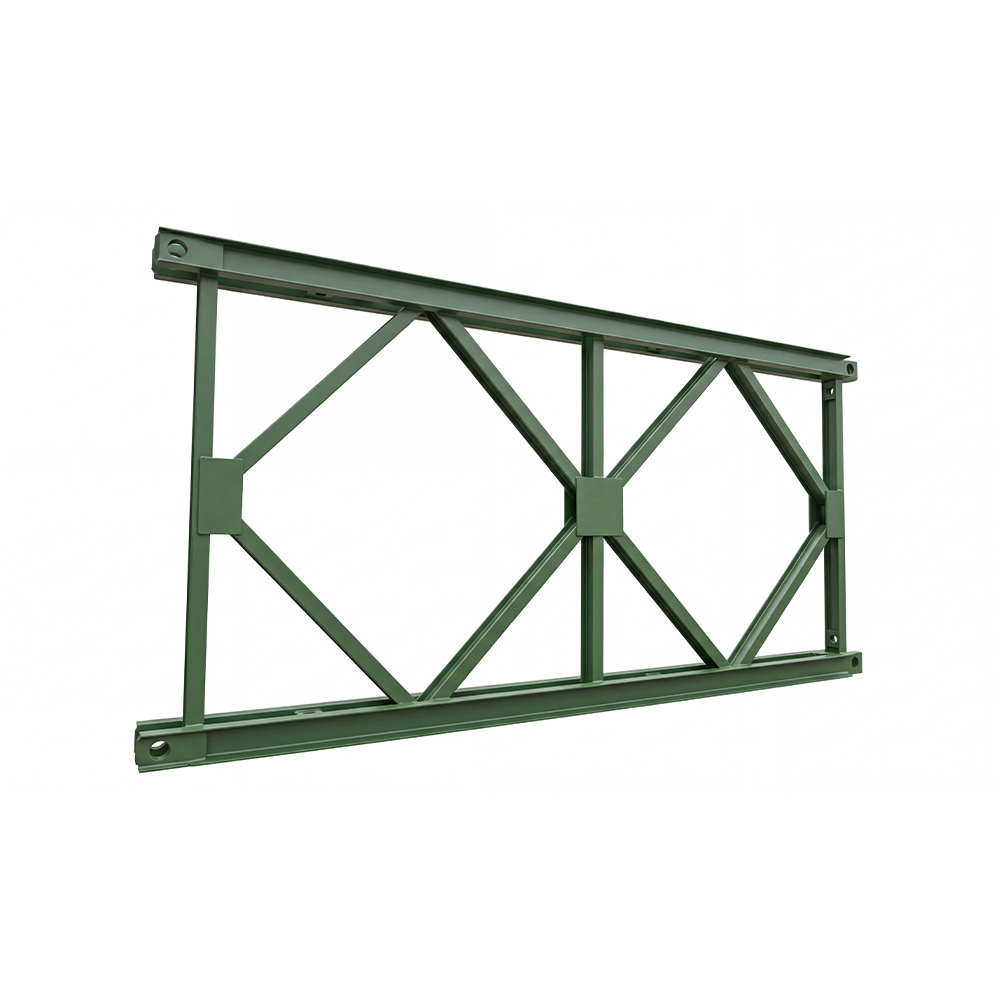
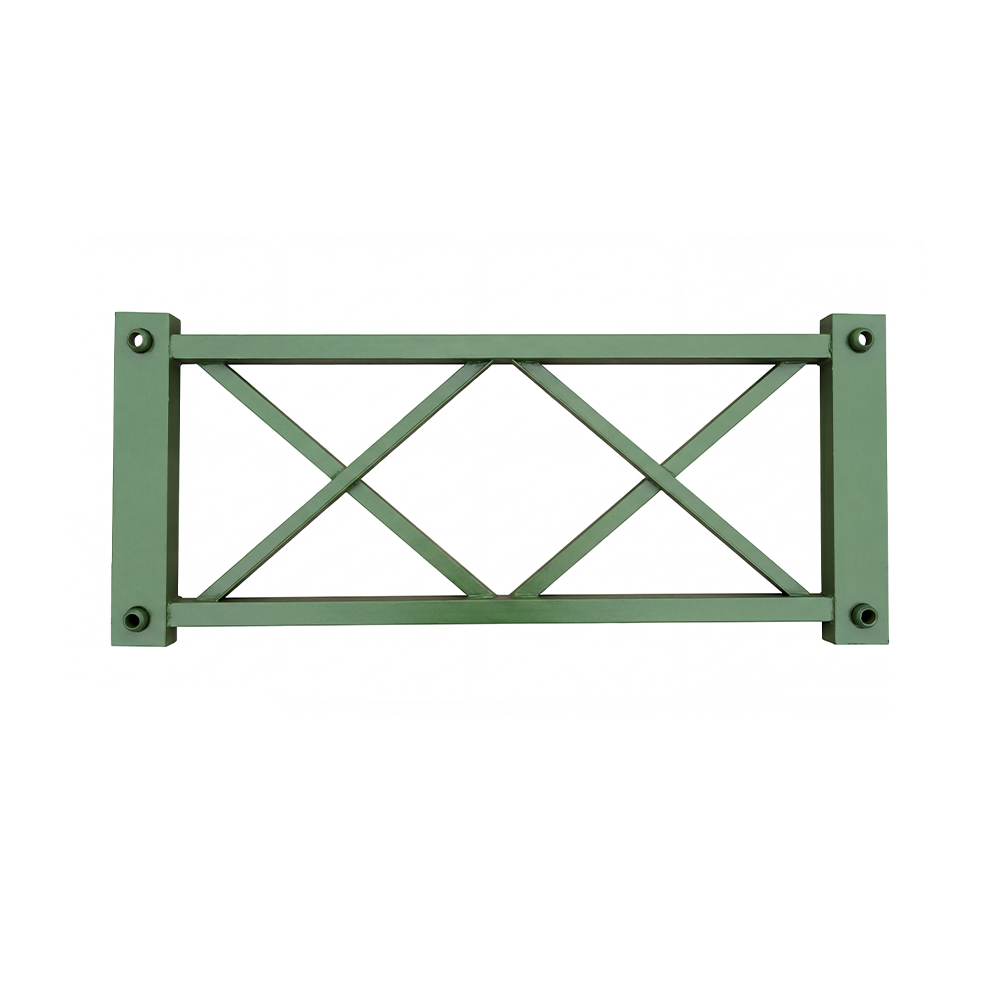
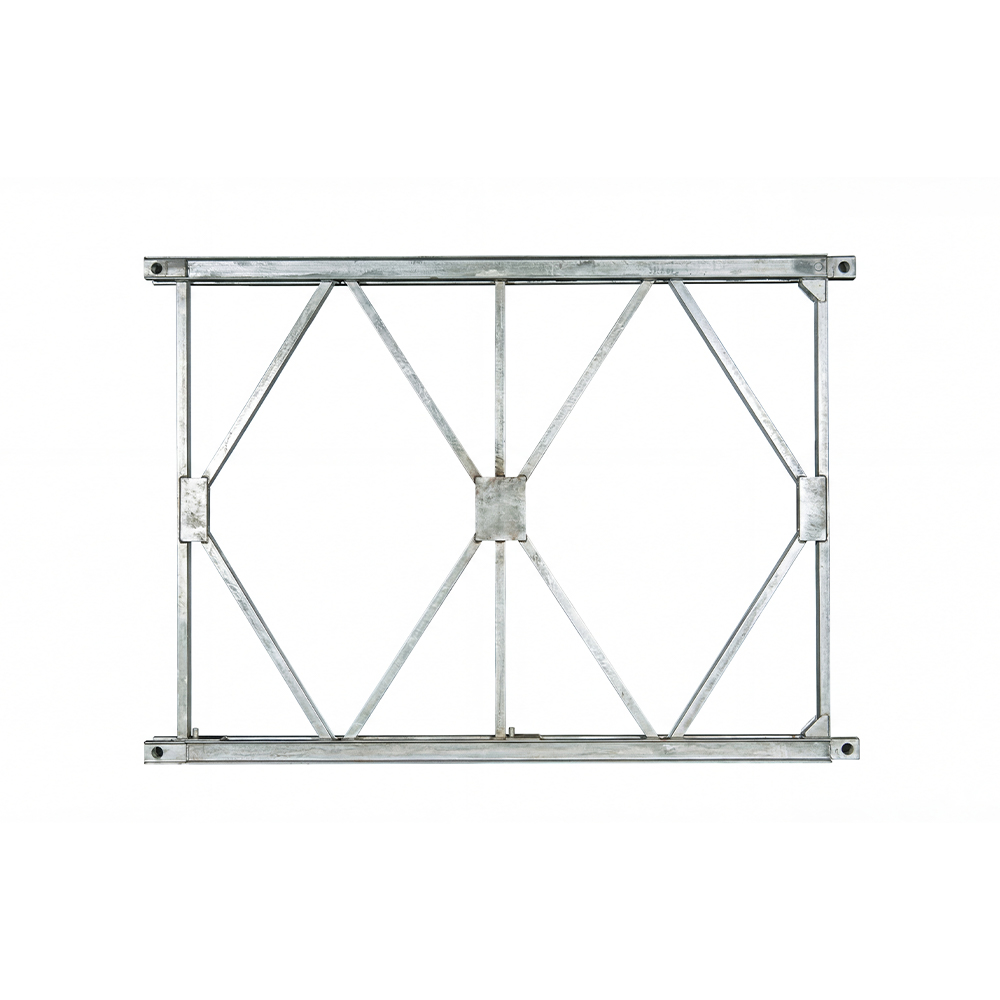
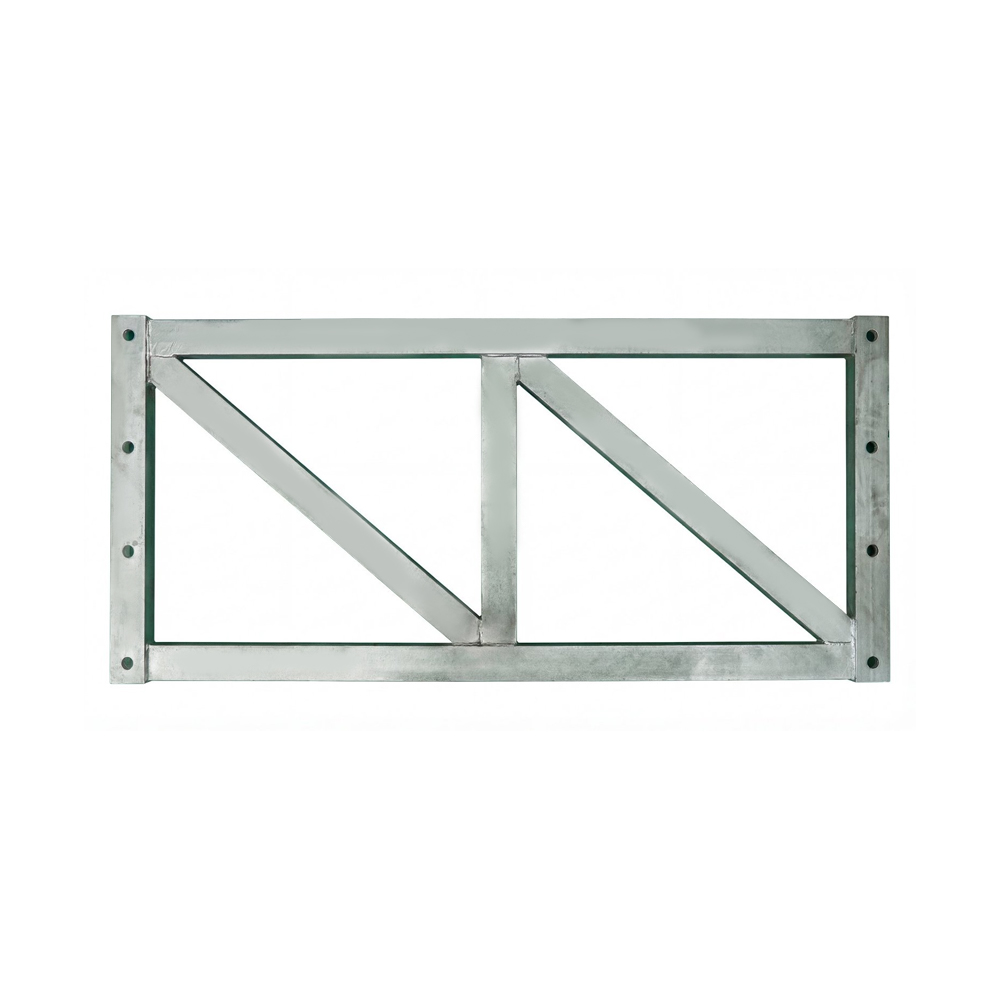
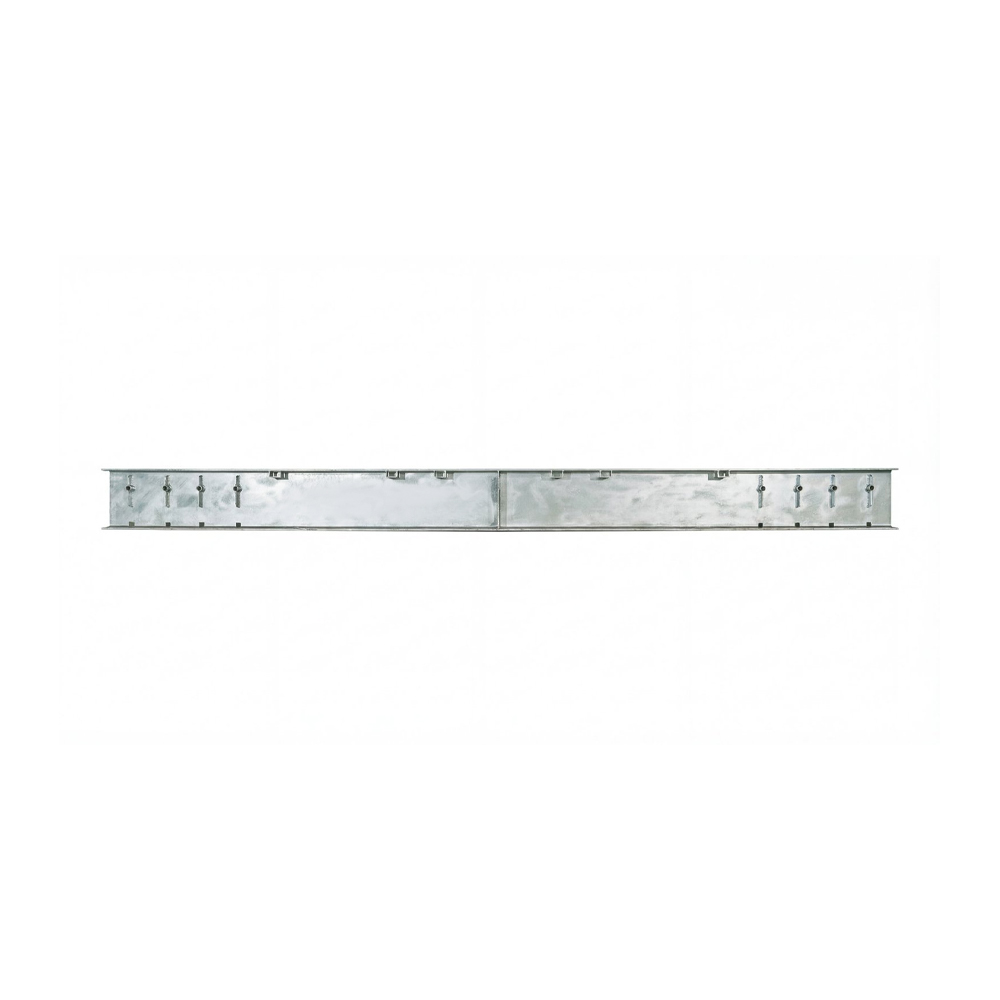
Everything in the Bailey system revolves around the standard rectangular panel: 10 feet (3.05 m) long and 5 feet (1.52 m) tall, weighing approximately 570 lb (258 kg). Each panel can be carried and positioned by a small team of soldiers without mechanical assistance. The panels interlock via simple pin-and-socket connections, allowing rapid assembly in virtually any sequence.
The elegant scalability of the system lies in its ability to be configured in single, double, or triple truss arrangements, and in single or double story (vertically stacked) configurations. This matrix of combinations allows engineers to dial in the precise load capacity and span required:
Table 1. Standard Bailey truss configurations and their corresponding span and load ratings.
| Configuration |
Max Span |
Load Capacity |
Typical Use |
| Single Single (SS) |
~40 ft (12 m) |
Class 30 |
Light military traffic, foot bridges |
| Single Double (SD) |
~80 ft (24 m) |
Class 40 |
Medium vehicle crossings |
| Double Single (DS) |
~100 ft (30 m) |
Class 60 |
Heavy military vehicles, tanks |
| Double Double (DD) |
~130 ft (40 m) |
Class 70+ |
Main supply routes, armor columns |
| Triple Double (TD) |
~200 ft (61 m) |
Class 100+ |
Major river crossings, heavy loads |
Load Classification
Military bridge load capacity is expressed in MLC (Military Load Classification), a standardized system. An MLC 70 bridge, for instance, can support vehicles with an equivalent gross weight factor of 70 — sufficient for most main battle tanks. The double-double Bailey configuration reaches this threshold while remaining entirely tool-free in assembly.
The Cantilever Launch Method
One of the Bailey bridge's most operationally significant features is how it is erected. Rather than requiring scaffolding or access to both banks simultaneously, it uses a cantilever push-out method: the bridge is assembled on one bank and progressively pushed across the gap using rollers and a temporary nose piece (a lightweight extension that prevents the structure from tipping forward during launch). Once the nose reaches the far bank, the rollers are removed, the deck is installed, and the bridge is complete.
Under combat conditions, a trained Royal Engineer squadron could erect a 100-foot double-single Bailey bridge in under three hours. In modern exercises, that time has been further reduced using prefabricated components and improved logistics.
Materials, Tolerances, and Steel Design
The original WWII-era Bailey panels were fabricated from high-tensile steel, heat-treated and cold-formed to achieve the necessary strength-to-weight ratio. The material choice was deliberate: mild steel would have required heavier sections to achieve equivalent load ratings, compromising the man-portable objective.
Modern iterations, including the Medium Girder Bridge (MGB) developed in the 1970s and the Mabey & Johnson Compact 200 system, retain the core modular truss philosophy while incorporating:
- Higher-grade steel alloys (S355 or equivalent) for improved yield strength
- Hot-dip galvanization for corrosion resistance in permanent or semi-permanent deployments
- Aluminum deck panels to reduce dead load and ease handling
- Improved pin connections with anti-rotation locking mechanisms
Engineering tolerances in modern Bailey-derived systems are typically held to ±1.5 mm on panel dimensions, ensuring interchangeability across production batches separated by decades — a critical consideration for legacy military stockpiles.
Civil and Humanitarian Applications
The Bailey truss bridge long ago transcended its military origins. Its modular, reusable, and rapidly deployable character makes it an ideal solution across a remarkable breadth of civilian infrastructure scenarios.
Disaster Relief and Emergency Bridging
In the aftermath of earthquakes, floods, and landslides, conventional bridge reconstruction can take months or years. Bailey bridges offer an interim solution deployable within hours. Following the 2015 Nepal earthquake, Bailey bridges were airlifted into remote highland areas to restore road access to communities whose only connections had been washed away. Similar deployments occurred after the 2004 Indian Ocean tsunami and Typhoon Hainan in the Philippines.
Remote Infrastructure Development
In developing regions where crane infrastructure is absent or road networks are too weak to transport precast concrete elements, Bailey-type bridges provide a practical alternative. The Mabey Bridge system — a direct commercial descendant of the Bailey design — has been installed across sub-Saharan Africa, Southeast Asia, and Latin America, often in locations accessible only by helicopter or pack animal.
The Compact 200 modular bridge system, derived directly from Bailey principles, has been installed in over 100 countries. In many rural communities in Africa and South Asia, it represents the first all-weather river crossing in recorded local history.
Temporary Industrial Access
Mining operations, hydroelectric dam construction, and pipeline projects frequently require heavy-haul access across rivers and ravines during the construction phase, after which the bridge may be dismantled and relocated. The Bailey truss bridge excels in this role: it can be removed and reused across multiple project sites, dramatically reducing the cost per installation compared to permanent structures.
Pedestrian and Cycle Bridges
Lighter Bailey configurations — particularly single-single arrangements with timber or aluminum decking — are increasingly used for pedestrian and cycle bridges in parks, nature reserves, and urban greenway corridors. Their visual character, honest structural expression, and relatively low cost have made them popular with landscape architects seeking an industrial-heritage aesthetic.
Advantages Over Alternative Bridge Types
The Bailey truss bridge occupies a specific and well-defined niche in the spectrum of bridge types. Understanding where it excels relative to alternatives helps clarify why it has remained relevant for over eight decades.
vs. Pontoon Bridges
Pontoon (floating) bridges are faster to deploy over wide water crossings but are sensitive to current, depth, and water traffic. They cannot carry the heaviest loads, and flood conditions can render them impassable. Bailey bridges, by contrast, are fixed structures independent of water depth and current velocity — critical in fast-moving rivers or seasonal flood zones.
vs. Prefabricated Concrete Bridges
Prefabricated concrete bridges offer excellent durability and low maintenance but require heavy lifting equipment, prepared abutments, and significant lead time. A Bailey bridge can be erected without cranes, on improvised abutments (including existing bridge ruins), and in a fraction of the time. For spans under 60 meters, the Bailey system frequently offers a better cost-time-access trade-off.
vs. Modern Modular Bridge Systems
Contemporary competitors such as the Acrow 700XS, Mabey Compact 200, and SURTASS military bridging all owe a direct intellectual and mechanical debt to the Bailey design. They offer improvements in panel strength, deck surface quality, and corrosion resistance, but the fundamental operating principle — pin-connected interchangeable panels assembled without specialist equipment — is Bailey's innovation, unaltered in concept.
Notable Bailey Truss Bridge Deployments
The history of the Bailey bridge is inseparable from some of the most dramatic engineering feats of the 20th and 21st centuries:
- Rhine Crossings, 1945: Allied forces erected multiple Bailey bridges across the Rhine within hours of breaching German defenses, enabling armored columns to advance before German engineers could destroy the permanent structures.
- Cassino, Italy, 1944: Sappers of the New Zealand Division erected a Bailey bridge under direct fire to allow tanks to cross the Rapido River during the Battle of Monte Cassino — one of the most cited examples of combat engineering under fire.
- Falklands War, 1982: British forces used Bailey bridging in the liberation of the Falkland Islands, improvising crossings over the archipelago's marshy terrain.
- Bosnia, 1995–2004: NATO IFOR and SFOR stabilization forces relied heavily on Bailey-derived bridging to restore transport links across war-damaged river crossings throughout Bosnia-Herzegovina.
- Afghanistan and Iraq, 2001–2021: Coalition engineers deployed Mabey and Bailey-derived bridging systems extensively for both military and civil reconstruction purposes across both theatres.
Modern Evolution: From Bailey to Modular Steel Bridging
The original Bailey design has been officially retired from frontline British Army service, replaced by the Medium Girder Bridge (MGB) and the Close Support Bridge. However, the underlying engineering philosophy has been refined rather than abandoned.
The MGB, for instance, retains the cantilever launch concept and modular panel assembly but uses box-section girders rather than open truss panels, achieving higher bending stiffness at reduced weight. Its panels are still man-portable and pin-connected — Bailey's original imperatives, preserved in a new geometric form.
Commercial systems like the Mabey Compact 200 and the Acrow Panel Bridge have brought Bailey principles into the civilian infrastructure market with greater customization, better corrosion treatment options, and third-party certification for highway loading standards (AASHTO, Eurocode). These systems now support permanent installations with design service lives of 50 years or more.
Meanwhile, surplus original Bailey bridging continues to serve in the armed forces of over 60 countries, many of which have maintained and stockpiled panels since the 1940s and 1950s — a remarkable testament to the quality of manufacture and the durability of the basic design.
Engineering Legacy and Influence
The Bailey truss bridge's influence on structural engineering extends well beyond bridging. Its approach to modular design — standardized components, tool-free assembly, scalable configuration, and complete interchangeability — prefigured principles that now underpin everything from scaffolding systems to prefabricated building structures.
In academic structural engineering, the Bailey bridge is frequently cited as a canonical example of design under constraint: the requirements of portability, speed of erection, and load capacity pulled in competing directions, and the elegance of the solution lay in finding a single panel geometry that satisfied all three simultaneously. That balance — a 10-foot by 5-foot steel rectangle, weighing 570 lb — remains one of the most consequential design decisions in the history of structural engineering.
Sir Donald Bailey received relatively little personal recognition during his lifetime compared to the magnitude of his contribution. He died in 1985, having spent most of his career as a quiet civil servant. The bridges bearing his name, however, continue to bear loads across rivers on every inhabited continent — a more durable monument than most engineers ever achieve.


 Français
 Español
 عربى
عربى