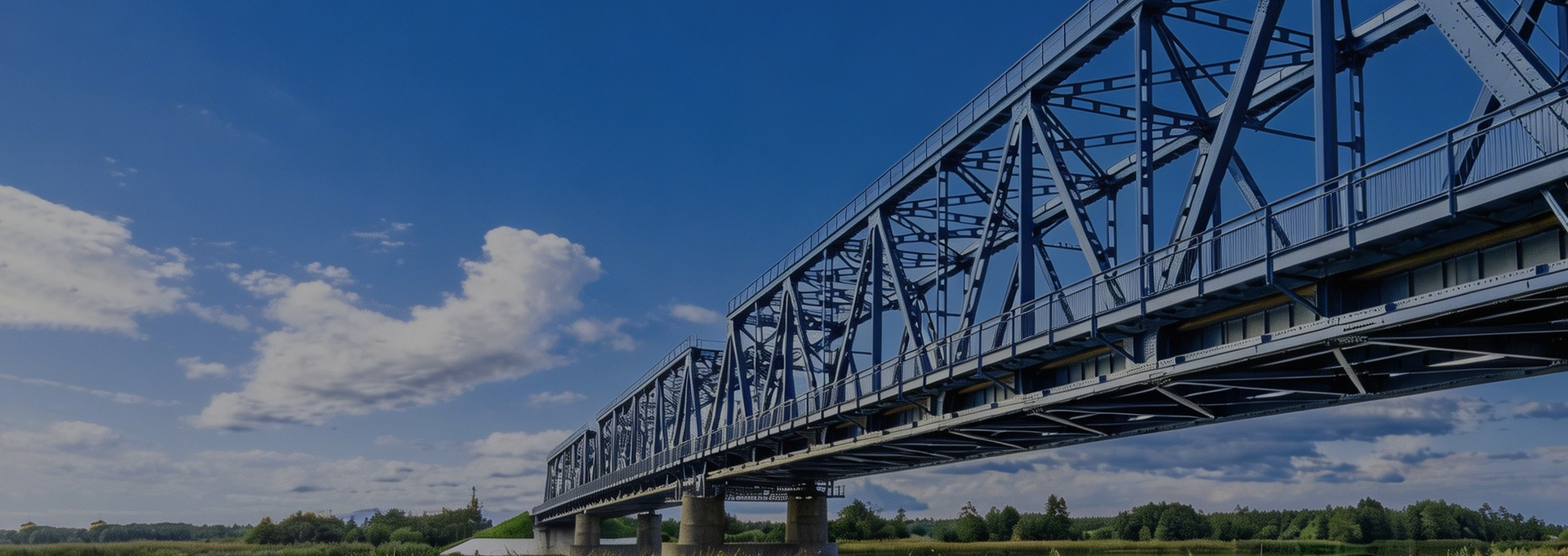
Bridges are among humanity's oldest and most consequential engineering achievements. Yet for all the variety of forms they take — from ancient stone arches to mile-long cable-stayed giants — virtually every bridge ever built can be understood through four fundamental structural types. These categories are not arbitrary classifications: they describe four fundamentally different ways of carrying load across a gap.
01 Beam Bridge
The simplest form. A horizontal span supported at each end, carrying load through bending.
02 Arch Bridge
Load is carried in compression along a curved form and transferred to the abutments.
03 Suspension Bridge
The deck hangs from cables draped over towers — load carried in cable tension.
04 Cable-Stayed Bridge
Cables run directly from towers to deck, providing support without a main suspension cable.
Understanding these four types means understanding the fundamental physics of how structures carry force. Each type has its own ideal span range, material demands, construction logic, and visual character. Together, they account for nearly every bridge built in the modern world — from a simple concrete overpass to the Golden Gate.
01
Bridge Type One
The Beam Bridge
The beam bridge is the most elementary of all bridge types and the most ancient. In its purest form, it is nothing more than a horizontal member — a beam — resting on two supports, one at each end. A fallen log across a stream is a beam bridge. So is a concrete freeway overpass.
How Beam Bridges Carry Load
When a load is applied to the top of a beam, the beam bends. This bending creates two simultaneous stress states: the top of the beam is squeezed in compression, while the bottom is stretched in tension. The structural challenge in beam bridge design is managing these two forces — maximizing the beam's resistance to bending without making it so heavy that its own weight becomes the dominant load.
This is why modern beam bridges almost never use solid rectangular beams. Instead, engineers use I-beams (also called W-sections or wide-flange sections): the two flat flanges at the top and bottom carry the compressive and tensile forces respectively, while the thin vertical web connecting them resists shear. This shape concentrates material exactly where the stresses are highest and removes it where it contributes little — a direct expression of structural honesty.
Truss Bridges: The Beam Refined
The truss bridge is best understood as a beam bridge that has been skeletonized. Rather than a solid or I-shaped beam, the structure is formed from a triangulated network of members, each working in either pure tension or pure compression. Triangles are the only geometric shape that cannot be deformed without changing the length of a member — making them the ideal structural primitive.
Common truss configurations include the Pratt truss (diagonal members in tension under normal loads), the Howe truss (diagonals in compression), the Warren truss (alternating triangles without vertical members), and the Vierendeel frame (rectangular panels without diagonals, relying on moment connections). Each configuration has different efficiency characteristics depending on loading patterns and span length.
The Bailey bridge — developed for military use in World War II — is a Pratt truss beam bridge. Its modular panel system allowed complete bridges to be erected without cranes by small teams of soldiers, often in under three hours.
Span Limits and Practical Applications
Beam bridges are economical and straightforward to construct for spans up to approximately 250 meters when using continuous multi-span arrangements. Beyond this range, the self-weight of the beam grows faster than its load-carrying capacity, making other structural strategies more efficient. For shorter spans — road overpasses, railway bridges, pedestrian crossings — the beam bridge remains the default choice worldwide due to its construction simplicity and cost efficiency.
~250m Practical span limit
60%+ Of all bridges worldwide
Steel / RC Dominant materials
Bending Primary force mechanism
02
Bridge Type Two
The Arch Bridge
The arch bridge is one of the oldest structural inventions in human history. Roman engineers built masonry arch bridges over 2,000 years ago that are still in daily use today — a testament to the durability of both the material and the structural concept. The arch's endurance comes from its elegant exploitation of compressive forces, working with rather than against the properties of stone and concrete.
The Structural Logic of the Arch
An arch carries load by converting the downward force of gravity into compressive thrust directed along the curve of the arch. Every load applied to an arch sends compression spreading outward and downward through the arch ribs toward the foundations. Critically, unlike a beam, an arch generates no internal tension under uniform loading — a profound advantage when building with materials like stone, brick, or unreinforced concrete that are strong in compression but weak in tension.
The critical design requirement is the abutment: the foundation at each end of the arch that resists the outward horizontal thrust. An arch without adequate abutments simply spreads apart and collapses. The Romans solved this by building arches into hillsides or providing massive masonry buttresses. Modern arch bridges use reinforced concrete or steel abutments anchored to bedrock.
Types of Arch Configuration
Modern arch bridges appear in several forms depending on the relationship between the arch and the deck:
- Through arch (bowstring arch): The deck passes through the arch at mid-height. The arch provides the structural backbone, and the deck is suspended from hangers. The Sydney Harbour Bridge and New River Gorge Bridge are iconic examples.
- Deck arch (half-through arch): The arch rises above the deck, which is supported from below. The arch is visible from the sides but the road sits on top.
- Tied arch: A horizontal tie member connects the two springing points (bases) of the arch, absorbing the outward thrust internally rather than transferring it to the ground. This eliminates the need for massive abutments and allows arch bridges to be built on soft ground.
- Fixed arch: The arch is rigidly connected to its abutments, sharing moments as well as axial forces — suitable for stable bedrock foundations.
The New River Gorge Bridge in West Virginia — a steel through-arch — spans 518 meters, making it one of the longest steel arch spans in the world. When it opened in 1977, it cut the travel time across the gorge from 45 minutes to 45 seconds.
Span Range and Ideal Conditions
Arch bridges become structurally competitive with suspension and cable-stayed designs for spans in the 200–550 meter range, particularly where strong rock abutments are available. In gorge crossings and river valleys with steep rocky banks, the arch is often the optimal structural choice: the canyon walls themselves act as natural abutments.
03
Bridge Type Three
The Suspension Bridge
The suspension bridge is the dominant structural choice for the world's longest spans. Its defining characteristic is the main cable — a massive bundle of high-strength steel wires draped in a catenary curve over two tall towers — from which the bridge deck hangs via vertical suspenders. The Golden Gate Bridge, the Akashi Kaikyō Bridge, and the Humber Bridge are all suspension bridges.
How Suspension Bridges Work
Load from traffic on the deck is transferred upward through the vertical suspenders into the main cables. The cables carry this load in pure tension — pulling the towers inward and pulling the anchorages outward. The towers rise in compression. The anchorages (massive concrete or rock-anchored foundations at each end) resist the outward pull of the cables.
The catenary shape of the main cable is not arbitrary: it is the exact curve a flexible cable adopts under its own self-weight, and it distributes load from the suspenders efficiently along the full cable length. Under traffic loading, the cable shape changes slightly from the pure catenary, introducing secondary bending into the stiffening girder below the deck — managing this interaction is a central challenge in suspension bridge design.
The Cable: A Marvel of Fabrication
The main cables of a suspension bridge are not a single rope but a bundle of thousands of individual high-strength steel wires — each roughly 5 mm in diameter — spun in place using a method called aerial spinning. On the Golden Gate Bridge, each of the two main cables contains 27,572 individual wires. The cables of the Akashi Kaikyō Bridge contain enough wire to circle the Earth seven times.
After spinning, the wires are compacted into a circular cross-section and wrapped in a protective sheathing. The resulting cable combines extraordinary tensile strength with flexibility — it can deflect significantly under asymmetric loading without losing structural integrity.
Aerodynamic Stability
The catastrophic 1940 collapse of the Tacoma Narrows Bridge — which resonated into destructive oscillation in a 64 km/h wind — transformed suspension bridge engineering. The investigation revealed that the original solid-plate deck acted like an aerofoil, generating aerodynamic lift forces that coupled with the bridge's natural frequency. Modern suspension bridges use open-grating or box-girder decks with carefully shaped cross-sections to minimize aerodynamic lift, and undergo extensive wind tunnel testing at reduced scale before construction.
The Akashi Kaikyō Bridge in Japan — currently the world's longest suspension bridge — has a central span of 1,991 meters. Its towers stand 298 meters above sea level and must flex up to 2 meters in either direction to accommodate typhoon winds.
Span Range and Limitations
Suspension bridges dominate for spans above roughly 500 meters, with current examples exceeding 1,900 meters. Theoretical analysis suggests that spans of 3,000–5,000 meters may be achievable with ultra-high-strength carbon-fiber cables, though no such structure has yet been built. The primary limitation is cost and complexity of the anchorage systems — in locations where bedrock is unavailable, creating adequate anchorages for the main cables becomes prohibitively expensive.
04
Bridge Type Four
The Cable-Stayed Bridge
The cable-stayed bridge is the most visually striking of the four types and the dominant choice for major new bridge construction worldwide over the past four decades. Its distinctive silhouette — arrays of taut cables radiating from one or more tall towers directly to the deck — is now an instantly recognizable feature of modern infrastructure landscapes.
Cable-Stayed vs. Suspension: A Critical Distinction
Cable-stayed bridges are frequently confused with suspension bridges, but the structural difference is fundamental. In a suspension bridge, the main cables carry load indirectly: they span from anchorage to anchorage, and the deck hangs from these cables via vertical suspenders. In a cable-stayed bridge, the cables run directly from the tower to the deck at an angle — there is no separate main cable. Each stay cable is an independent structural member connecting a specific point on the deck to a specific point on the tower.
This distinction has major consequences:
- Cable-stayed bridges do not require large external anchorages — the horizontal components of the cable forces cancel out within the deck itself (which acts as a compression strut between the cable attachment points on each side of the tower).
- They are stiffer under asymmetric loading, because each cable provides direct, individual support to its deck attachment point.
- They can be built using the free-cantilever method: the deck is built outward from the tower in balanced segments, with each new segment supported by its own new stay cable — no falsework or temporary supports are required mid-span.
The Millau Viaduct in France — a cable-stayed structure carrying the A75 motorway across the Tarn River valley — has one pier standing 245 meters above the valley floor, making it taller than the Eiffel Tower at road level. At its construction, it was the tallest vehicular bridge in the world.
Tower Configurations
The tower (or pylon) of a cable-stayed bridge is the structural heart of the system, and its shape carries both structural and aesthetic significance. Common configurations include:
- H-frame (twin towers): Two parallel vertical towers connected by a cross-beam. Provides good lateral stiffness. Common in earlier cable-stayed designs.
- A-frame: Two towers meeting at a point above deck level. The inclined legs improve lateral resistance and create a distinctive visual profile.
- Diamond / inverted Y: The tower splays outward at the base, providing exceptional resistance to lateral cable forces. Used on wide bridges where stay cables fan to both sides of a wide deck.
- Single plane (mono-pylon): A single central tower with cables in a single vertical plane running along the bridge centerline. Common in narrower pedestrian or light-rail bridges where visual slenderness is prized.
The Fan vs. Harp Cable Arrangement
Stay cables can be arranged in two primary patterns. In a fan arrangement, all cables converge toward a single point at the top of the tower — maximizing the angle between cable and deck (which maximizes the vertical component of cable force), but concentrating loads at the tower tip. In a harp arrangement, cables are parallel and attach at different heights on the tower — easier to inspect and replace, visually elegant, but slightly less structurally efficient for very long spans.
Span Range and Global Dominance
Cable-stayed bridges are most competitive for spans between approximately 200 and 1,100 meters. They have largely displaced suspension bridges in this range due to lower cost, faster construction using free-cantilever methods, and reduced foundation demands. The Russky Bridge in Russia (1,104 m central span) currently holds the record for the world's longest cable-stayed span.
Comparing the Four Bridge Types
Each bridge type occupies a distinct structural niche. The choice between them for any given project depends on span length, ground conditions, available materials, construction logistics, and budget.
| Bridge Type |
Primary Force |
Span Range |
Key Requirement |
Famous Example |
| Beam |
Bending (tension + compression) |
Up to ~250 m |
Stiff beam or truss |
Lake Pontchartrain Causeway |
| Arch |
Compression |
50 – 550 m |
Strong abutments or tied deck |
Sydney Harbour Bridge |
| Suspension |
Cable tension |
500 – 2,000 m+ |
Massive anchorages + tall towers |
Golden Gate Bridge |
| Cable-Stayed |
Cable tension + deck compression |
200 – 1,100 m |
Tall towers, no external anchorage |
Millau Viaduct |
How Engineers Choose a Bridge Type
In practice, selecting a bridge type is rarely a simple lookup table exercise. Engineers weigh a complex matrix of factors, and the "correct" answer often depends on site-specific constraints that cannot be fully anticipated in advance.
Span Length
Span is the primary determinant. For gaps under 50 meters, beam bridges are almost universally chosen for their economy. From 50 to 200 meters, arch and truss solutions become competitive. Beyond 500 meters, only suspension and cable-stayed bridges are practical. The crossover between these ranges is not a hard boundary — topography, budget, and construction access can shift the optimal choice significantly.
Geology and Foundation Conditions
Arch bridges and suspension bridges with external anchorages require excellent foundation rock — the horizontal thrust forces involved are enormous. Cable-stayed bridges, with their self-anchored decks, and beam bridges, with only vertical reactions, can be built on softer ground. This is one reason cable-stayed bridges have displaced suspension designs in many recent projects: the anchorage problem is simply removed from the equation.
Construction Method
Some locations make temporary falsework impossible — bridges over navigable rivers, deep gorges, or active railways cannot be built from below. Cable-stayed bridges' free-cantilever construction method, arch bridges' staged centering, and suspension bridges' aerial cable-spinning all allow construction without mid-span support. Beam bridges often require launching gantries or incremental launching to avoid temporary piers.
Material Availability and Cost
In regions where structural steel is expensive or difficult to import, reinforced and prestressed concrete alternatives to steel beam and arch designs are often preferred. The Salginatobel Bridge in Switzerland — a slender concrete arch designed by Robert Maillart — was chosen specifically because it used less material than a steel beam alternative, at lower total cost, in a remote Alpine valley.
Beyond the Four Types: Hybrid and Composite Structures
While the four categories describe the fundamental structural logic of bridges, real engineering rarely fits neatly into a single box. Many significant bridges combine principles from multiple types:
- Cable-stayed arch hybrids: Some modern bridges use an arch as the primary structure while adding cable-stays to stiffen the deck — combining the compressive efficiency of the arch with the direct deck support of cable-stayed geometry.
- Extradosed bridges: A hybrid between a beam and a cable-stayed bridge, extradosed bridges use relatively low towers and shallow-angle cables to partially prestress the deck — suitable for spans in the 100–250 m range where full cable-stayed towers would be disproportionately tall.
- Truss suspension: The original Niagara Falls Railway Suspension Bridge (1855) used a stiff truss as the deck stiffening element — an early recognition that flexible suspension decks needed rigid reinforcement.
These hybrid forms demonstrate that the four bridge types are not rigid taxonomic boxes but points on a structural continuum. As materials improve — particularly with the advent of carbon fiber composites and ultra-high-performance concrete — the boundaries between categories will continue to blur, and entirely new structural strategies may emerge.
The Enduring Logic of Bridge Structures
The four types of bridges — beam, arch, suspension, and cable-stayed — represent four distinct answers to the same fundamental engineering problem: how to carry load across a gap efficiently, safely, and durably. Each solution exploits a different combination of tension, compression, and bending; each is optimized for a different scale and context.
What is remarkable is how little the underlying principles have changed in two thousand years. A Roman engineer transported to the site of the Akashi Kaikyō Bridge would not recognize the materials, the scale, or the construction methods — but the logic of the arch, the beam, and the suspended cable would be immediately familiar. The geometry of structural force is the same in every era.
For anyone seeking to understand the built environment — as a traveler, a student, or simply a curious observer — recognizing these four structural families transforms bridges from anonymous infrastructure into legible expressions of force, material, and ingenuity. Every crossing tells you, in the language of its shape, exactly how it does its job.


 Français
 Español
 عربى
عربى